Libertarianism 101: Both Parties Went After Food Additives. Libertarians Would Let You Choose.
The Trump administration and New York lawmakers both targeted food additives, and a Democratic governor vetoed the state ban over costs. A left-right line can't map that. Two axes can.
New York Gov. Kathy Hochul, a Democrat, on Friday vetoed a bill to ban Red No. 3, a cherry-red dye, and two other additives, and her office led its defense with pizza and bagels.
One of the three, potassium bromate, "is often used for pizza and bagels," WXXI News reported. The station quoted a Hochul spokesperson: with those foods, "the only thing that should rise is the dough, not the cost."
In April 2025, President Donald Trump's health department said it would "phase out all petroleum-based synthetic dyes from the nation's food supply." Health Secretary Robert F. Kennedy Jr. said the dyes "pose real, measurable dangers to our children's health and development."
The result is a puzzle for the usual left-right map. The Trump administration and New York's Legislature reached for the same power over your plate. A Democratic governor blocked the state version over cost, though her spokesperson called its goal "laudable."
The bill would also have made companies report safety findings on ingredients they deem "generally recognized as safe." The Assembly had passed it 106-32.
"Food companies insist they've done the safety testing already. New York lawmakers were just asking them to show their work," said Jensen Jose, senior regulatory counsel at the Center for Science in the Public Interest (CSPI), a nutrition advocacy group that called the measure "bipartisan-backed."
The Food and Drug Administration (FDA) is pulling Red No. 3 from food anyway, under a 1960 provision barring additives shown to cause cancer in animals, after high doses caused cancer in male lab rats. But the agency says "there is no evidence" that Red No. 3 causes cancer in humans.
A straight line misleads
F.A. Hayek named the problem in 1960. He was a classical liberal, meaning someone who wants government kept small so people can run their own lives.
In "Why I Am Not a Conservative," Hayek wrote: "They are usually represented as different positions on a line, with the socialists on the left, the conservatives on the right, and the liberals somewhere in the middle. Nothing could be more misleading."
His fix was a triangle.
Two axes, five types
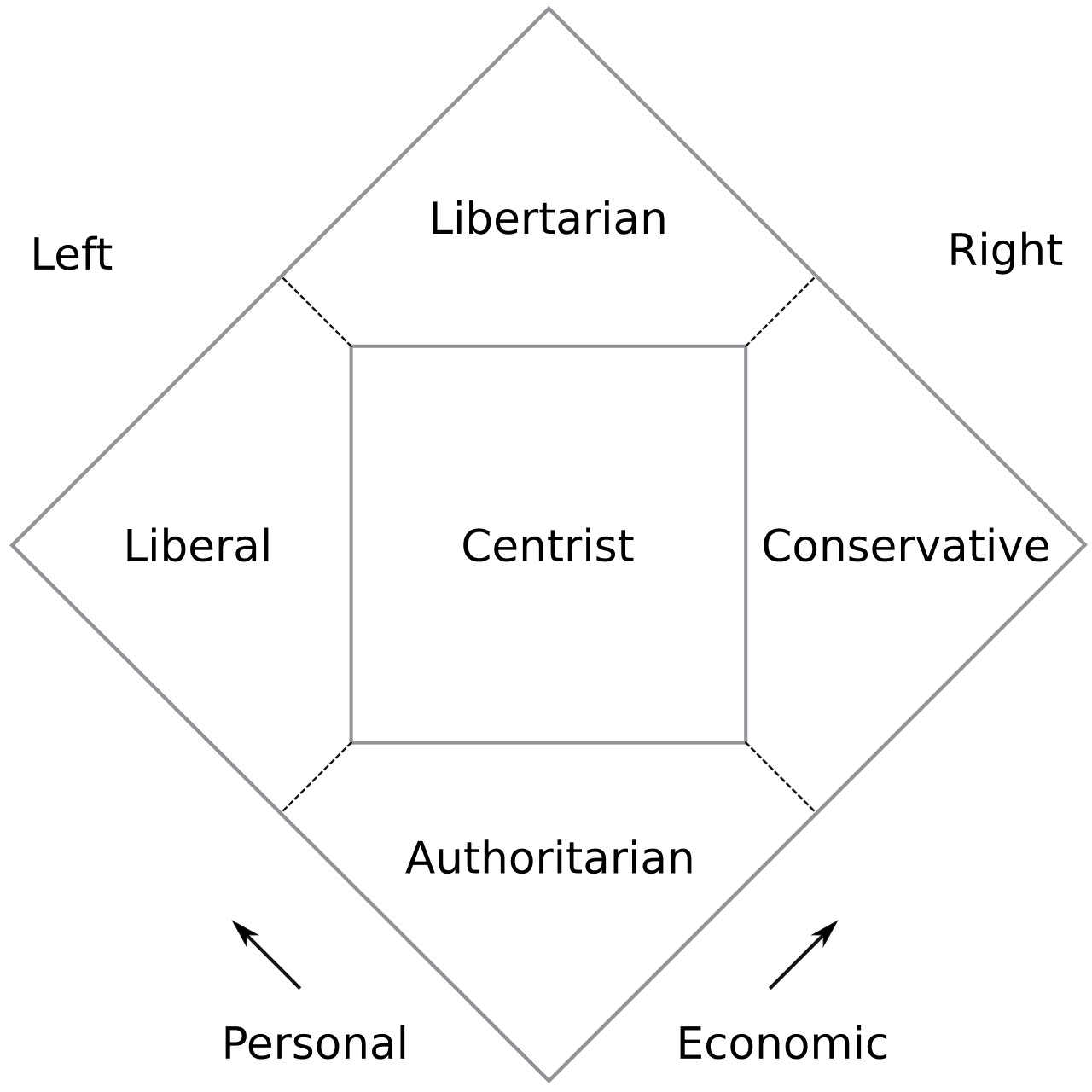
In 1969, David Nolan devised a chart with two axes, personal freedom and economic freedom. Marshall Fritz, founder of the Advocates for Self-Government, built the World's Smallest Political Quiz on it in 1987. The group says it "has been taken more than 27 million times," about 1,900 a day on average.
Ten questions, five personal and five economic, produce two scores that place you in one of five types:
- Libertarian: "More freedom in both your personal life and the economy."
- Progressive: "More personal freedom, more government role in the economy."
- Conservative: "More economic freedom, more government role in personal life."
- Authoritarian: "More government control in both areas."
- Moderate: "Middle ground on both, often depending on the issue."
Allies on both sides
Libertarians side with progressives on personal freedom. On business, Hayek wrote, conservatives usually oppose government planning of industry, "and here the liberal will often find allies in them." The catch: "conservatives are usually protectionists," shielding home industries from foreign competition, and "have frequently supported socialist measures in agriculture."
On food, both parties reached for government. The Libertarian Party platform says: "Individuals have the freedom and responsibility to decide what they knowingly and voluntarily consume, and what risks they accept to their own health, finances, safety, or life."
One fair knock: all 10 quiz statements are worded so that agreeing means less government, and every "Agree" is worth 20 points. But a map earns its keep on real fights, and on additives Washington and Albany's lawmakers sit in the same corner: more government.
Veto or no veto, the FDA says food makers must stop using Red No. 3 by Jan. 15, 2027.
The libertarian take
Opinion, from a libertarian perspective.
Washington and Albany both reached for bans. Albany's died over costs, bagels first.
Libertarians have a simpler rule: tell people what's in the food, then let them decide. CSPI has a point on disclosure, and "show their work" is a fair demand. But Albany bundled it with a ban, and the ban decides for you. Federal rules already require Red No. 3 on the ingredient list. If a dye worries you, buy the box without it.
Sources
- F. A. Hayek, "Why I Am Not a Conservative," The Constitution of Liberty (1960; Definitive Edition, University of Chicago Press, 2011), excerpt
- Advocates for Self-Government, "World's Smallest Political Quiz" page (accessed Nov. 23, 2026)
- Libertarian Party, Platform (accessed Nov. 23, 2026)
- New York State Assembly, bill record for S1239F, Food Safety and Chemical Disclosure Act (vetoed Nov. 20, 2026)
- U.S. Food and Drug Administration, HHS and FDA release on phasing out petroleum-based synthetic dyes (April 22, 2025)
- U.S. Food and Drug Administration, FD&C Red No. 3 page (accessed Nov. 23, 2026)
- Center for Science in the Public Interest, release on the New York veto (Nov. 20, 2026)
- National Governors Association, Gov. Kathy Hochul profile (party: Democratic)
This article was written by AI from a libertarian perspective and checked against the primary sources linked above. Our standards